
Top Signs You Need Garage Door Service – Don’t Ignore These
The top signs you need garage door service are a door that hesitates before moving, a floor gap that isn’t even, a door that reverses before it reaches the ground, and new noises you can’t place. Catching these early usually means a simple adjustment instead of a broken-spring emergency. A garage door that hesitates for half a second before moving isn’t just old. It’s often a torsion spring that’s lost tension, forcing the opener to work harder than it was built to. That motor has weeks, not months. If you’d rather not crawl around with a flashlight, call (844) 524-5950 and we’ll take a look.
Key Takeaways
- A half-second hesitation is usually a spring losing tension, not the opener wearing out.
- An uneven gap under the closed door means bent track or a failed roller, not settling.
- Grinding, popping and scraping are three different problems with three different fixes.
- A 30-second manual balance test tells you if the spring system is failing before it breaks.
- A door taking noticeably longer to open is carrying more mechanical load, not calling for a new motor.
What does a garage door that hesitates actually mean?
A hesitation before the door moves almost always traces back to the spring system, not the motor. When a torsion spring loses tension, it stops helping lift the door’s weight. The opener takes over that load and labors every cycle. In our experience across Genie and LiftMaster systems, a door that stumbles at the start of travel is the single most misread symptom homeowners report.
Here’s the trap. The hesitation feels like a motor problem, so people start researching replacement openers. But if the spring is the culprit, a new opener gets bolted to the same failing spring and wears itself out too. The load doesn’t go away because the motor is newer.
What to check instead: watch the door through a full open and close cycle. If it struggles most in the first few inches of travel and then smooths out, the spring is the suspect. If it strains evenly across the whole cycle, look at rollers and hinges. That distinction matters, and it’s the first thing we test on a service call.
Why is there a gap under my closed garage door?
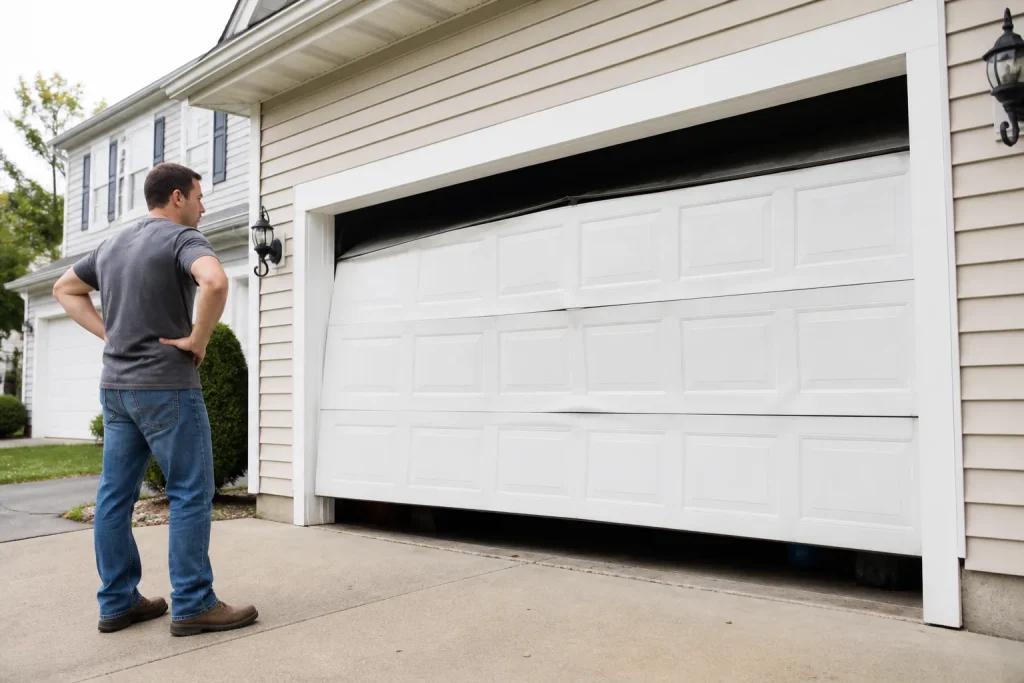
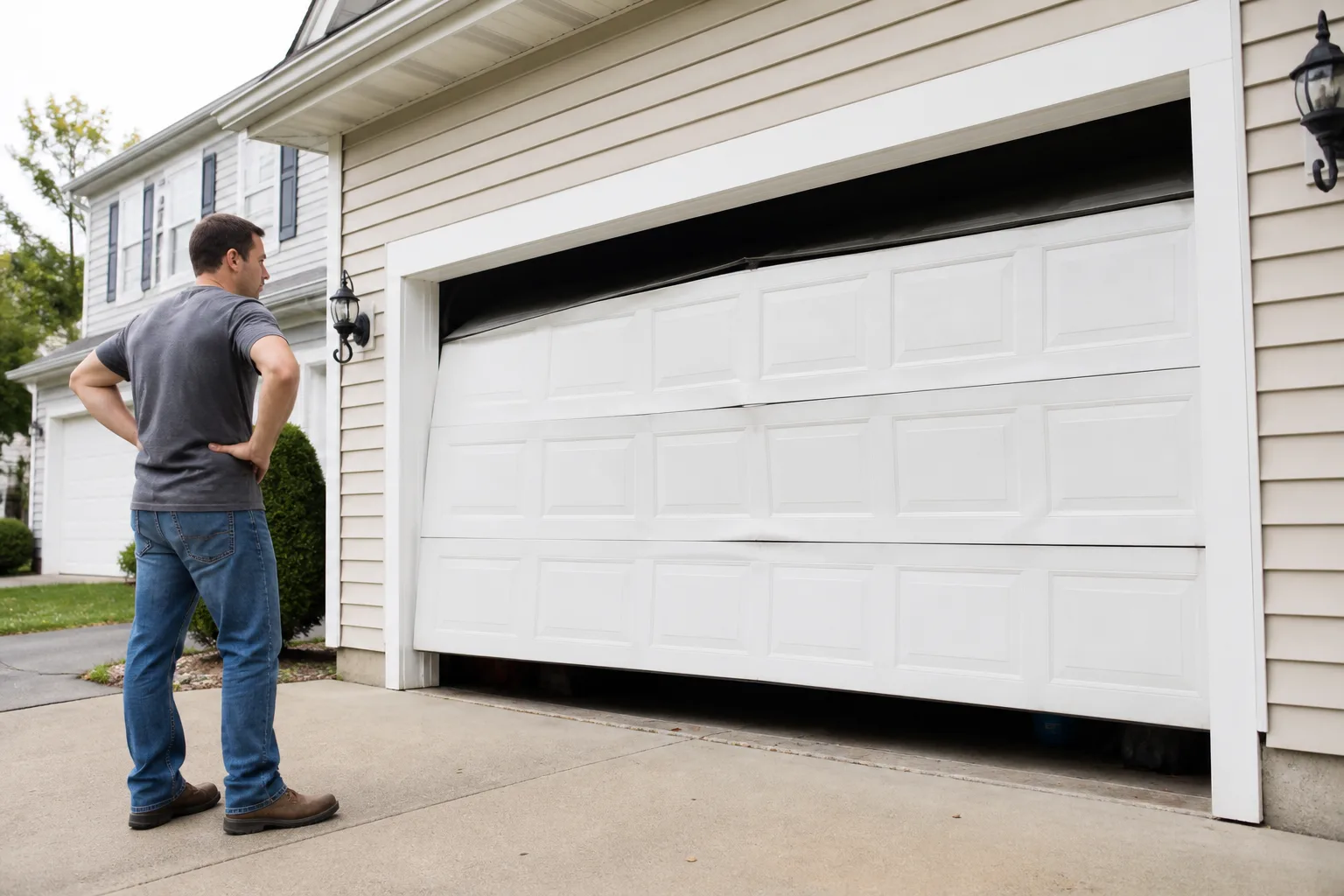
An uneven gap under a closed door points to a bent track or a failed roller, not your foundation settling. Stand inside with the door shut and look at the daylight. A gap that’s wide on one side and tight on the other is a door that’s no longer tracking straight in its rails.
This one earns its own section because it fails two ways at once. A door that won’t sit flush leaves a gap for weather and pests, and it also means the door isn’t fully secured. A homeowner in Arlington might notice the draft in winter before they ever notice the security side of it.
What usually bends a track: a car nudged a little too far into the bay, a door run with a broken roller, or a door that hit an obstruction and torqued sideways. Once a track is out of alignment, the rollers wear faster and the gap gets worse. Straightening a bent track and replacing worn rollers is a manageable repair when caught early. Left alone, a misaligned door grinds its way through the whole hardware set.
Why does my door reverse before it hits the floor?
A door that goes back up before touching the ground is often a cable jump, not a sensitivity setting. Most people reach for the opener’s travel limits and force adjustment. That’s the wrong dial. When a cable jumps its drum, the door moves unevenly and the opener senses resistance it reads as an obstruction. It reverses to protect itself.
Cable jumps usually trace back to a worn drum, a spring that’s lost tension, or a door that’s gone crooked in the track. Tensioning or replacing a torsion spring and re-seating a cable is dangerous work. High-tension springs and cables store serious energy, and a snap can cause serious injury. This is one to leave to a trained technician.
What you can safely check: whether the door sits level when open, and whether one side lags the other. If it does, stop cycling it. A crooked door under power puts stress on parts that should be carrying none.
What do the noises mean? Grinding, popping, scraping
Each noise points to a different part, and using the sound to find the problem saves time and money. Here’s how we sort them on a call:
- Grinding – worn roller bearings or dry hinges. The roller is dragging instead of rolling. Usually a hardware-level fix, not a spring issue.
- Popping – spring coil fatigue. A popping or snapping during travel often means the spring is binding or has a fatigued section. Address it before it breaks outright.
- Scraping – track misalignment. Metal on metal where the door meets the rail. Leave it and the door wears grooves into the track.
Lubrication quiets a grinding roller for a while, which is why people think the problem is solved. It isn’t. The bearing is still on its way out. If you hear any of these three and can’t place which one it is, a quick diagnosis settles it quickly. Fast diagnosis, right parts, lasting fix – that’s the sequence, and the noise is the starting point.
How do I do a 30-second balance test?
The manual balance test tells you whether the spring system is failing before a spring actually breaks. Do it with the opener disconnected. Most openers have a release cord or lever for exactly this. Pull it, then lift the door by hand about halfway and let go.
- Door stays put – springs are carrying the weight as they should. Good sign.
- Door drifts down or slams – the springs have lost tension and are no longer holding the load. This is why the opener has to work so hard.
- Door is very hard to lift by hand – same story from the other direction. The springs aren’t doing their share.
Whether the door drifts or fights you by hand, the spring system is the suspect. Don’t try to adjust spring tension yourself – that’s the one part of a garage door that genuinely isn’t a homeowner job. Once a technician confirms the springs, replacing a matched pair rather than one spring is standard practice, since both have lived the same cycles.
Is a slower door a sign the opener is dying?
A door taking noticeably longer to open usually isn’t the opener’s fault. Most openers move at a consistent cycle time. When that time stretches, the mechanical load has gone up. The motor is telling you something in the door is harder to move than it used to be.
Common culprits: dry or seizing rollers, a track that’s out of alignment, worn hinges, or a spring slowly losing its lift. None of those get fixed by swapping the motor. You just put fresh load on a new opener and shorten its life.
The load can build for weeks before the door quits. Cycle time is a great early indicator because you don’t need tools to notice it – just a rough sense of how long the door used to take. Clopay, Amarr and Wayne Dalton doors all show the same pattern: the door gets slower, then one day it stops mid-cycle. The slow phase is the window where a real fix is cheap.
When should you call a pro?
Call a pro when the sign involves springs, cables, or anything leaving the door crooked or off its track. Those parts are under high tension and can fail suddenly. For soft signs – a grinding roller, a worn hinge, a slightly noisy cycle – a technician can handle it in a single visit before it grows into something bigger.
Our technicians have up to 10 years of experience, and they’ve seen how the same symptom can mean a two-minute adjustment on one door and a full spring replacement on the next. The door, the opener and the springs are one system. That’s why we do all three and nothing else. Garage doors are all we do, which means we work on the brand you already have rather than steering you toward a particular system. If it’s Genie, LiftMaster, Chamberlain, Clopay, Amarr, Wayne Dalton, Craftsman or Raynor, we know the part and the likely failure pattern.
Get in touch with Arlington Garage Door Repair Experts for fast diagnosis and a lasting fix.
Related services in Arlington
If a sign above matches what your door is doing, the next step depends on which system it is. Spring symptoms point to garage door spring repair. Opener hesitation or a reversing door points to garage door opener repair. Track gaps, bent rails or rollers point to garage door repair. One call covers all three, and the written estimate tells you the price before any work starts.
What happens when you call
- 1
A real person answersNo phone trees – you reach a local pro.
- 2
You get an upfront price rangeHonest numbers before anyone is dispatched.
- 3
A background-checked tech heads outLicensed & insured, dispatched right away.
- 4
You approve before work beginsNothing starts until you say go.
The Bottom Line
Most garage door failures announce themselves long before they happen. A hesitation, an uneven gap, a new grind, a slow cycle – each one is a sign, not a nuisance. Catching them early is the difference between a small adjustment and a broken-spring emergency. Door, opener, springs: it’s one system, and a specialist sees the whole picture. If you’re in Arlington and need help, Arlington Garage Door Repair Experts offers free estimates – call (844) 524-5950. We answer 24/7. Fast dispatch from 7am to 7pm, Sunday through Friday.
Frequently Asked Questions
The earliest signs are a hesitation before the door moves, an uneven gap along the floor when closed, a door that reverses before hitting the ground, and new grinding or popping noises. A door that takes longer to open than it used to is another early signal. Catch any of these and you’re usually looking at a small fix rather than a breakdown. Call (844) 524-5950 for an exact quote – estimates are free.
Yes, in most cases. We offer same-day service for hinge, roller, track and opener issues, and fast dispatch from 7am to 7pm, Sunday through Friday. We answer 24/7, so a call placed outside dispatch hours is booked into the next opening. Call (844) 524-5950 and we’ll get you on the schedule.
No. The price is quoted and agreed before any work starts, and the written estimate sets the final price. You’ll know the number before a technician touches the door. Call (844) 524-5950 for an exact quote – estimates are free.
Yes. The local pro we connect you with is licensed and insured as their state requires. We specialize in garage doors only, so the person at your door works on springs, openers and panels every day. Call (844) 524-5950 to book a free estimate.
Written by the team at Arlington Garage Door Repair Experts.
Need Garage Door Help?
Call Arlington Garage Door Repair Experts - the local pro we connect you with is licensed and insured, here with fast help in Arlington.
(844) 524-5950